

Deepen the reform of sewage outlet management and fight the battle to protect the clear water
Strengthening and standardizing the supervision and management of river and sea discharge outlets (hereinafter referred to as discharge outlets) plays an important role in improving the quality of water ecological environment, promoting green development, protecting and building beautiful rivers, lakes, and bays. It is a powerful lever for deepening the battle to defend blue water and an important measure to promote the modernization of ecological environment governance system and governance capacity. Since the 1980s, laws such as the Water Law, Environmental Protection Law, Marine Environmental Protection Law, and Water Pollution Prevention and Control Law have made regulations on the management of sewage outlets. The regulations on river management and nature reserves further clarify the specific requirements for the approval, supervision, and management of the establishment of sewage outlets. The Ministry of Water Resources, the former State Oceanic Administration, the former Ministry of Environmental Protection and other departments have actively explored and carried out a large amount of work in their respective fields, achieving positive results. Since the transfer of management responsibilities for the establishment of river discharge outlets to the Ministry of Ecology and Environment in 2018, the ecological environment system has solidly carried out pilot projects for the investigation and rectification of discharge outlets in the Yangtze River, Yellow River, and Bohai Sea, explored and accumulated experience, and achieved positive results.
Recently, the General Office of the State Council issued the "Implementation Opinions on Strengthening the Supervision and Management of Pollutant Discharge Outlets into Rivers and Seas" (hereinafter referred to as the "Implementation Opinions"), which clearly put forward major measures to deepen the reform of pollutant discharge outlet setting and management.
Deeply understand the significance of formulating and issuing the 'Implementation Opinions'
The Implementation Opinions closely focus on building a harmonious symbiotic relationship between humans and water, grasping the overall laws of the ecological system in the basin and sea areas, adhering to the system concept, and proposing the basic principle of "water land coordination, water based shore" for the supervision and management of sewage discharge outlets entering rivers and seas. It coordinates the water and land on the shore, the ocean on land, as well as the upstream and downstream, left and right banks of the basin, and promotes the continuous improvement of the ecological environment quality in the basin and sea areas. Starting from the focus on tackling prominent water ecological and environmental problems around the people, using sewage outlets as a starting point, through investigation and tracing, we can understand the entire process from pollutant generation to discharge into rivers and seas, implement classified policies, and systematically rectify them. Standardize the establishment of new sewage outlets, force onshore pollution control, drive green transformation of economic and social development, and promote the construction of a beautiful China.
The formulation and promulgation of the Implementation Opinions is an important action to implement the principles of precise pollution control, scientific pollution control, and lawful pollution control. General Secretary Xi Jinping emphasized the need to adhere to precise pollution control, scientific pollution control, and law based pollution control, maintain strength, extend depth, and broaden breadth, and continue to fight for the defense of blue skies, clear waters, and clean land. The Implementation Opinions highlight legal supervision, require the formulation of regulations and technical standards for the supervision and management of pollutant discharge outlets, implement a review and filing system for the establishment of pollutant discharge outlets in accordance with laws and regulations, and timely disclose information on pollutant discharge outlet review and filing to the public in accordance with the law. Strictly investigate and rectify, and ban according to law the sewage outlets set up in violation of laws and regulations. Intensify law enforcement efforts and impose penalties on responsible parties who violate laws and regulations by setting up discharge outlets or not discharging according to regulations; Strictly investigate and punish the responsible parties who evade supervision and management and discharge pollutants through channels in accordance with the law. Highlight precise supervision, clarify the type of pollutant discharge outlet based on the industry and emission characteristics of the responsible party, and focus on intercepting and controlling pollution to carry out precise classification and rectification of pollutant discharge outlets. Efforts should be made to coordinate the rectification of sewage outlets in public enterprises, institutions, residential communities, and other areas that are closely related to people's lives, in order to avoid harming the immediate interests of the people and ensure the safety and orderliness of the rectification work; For enterprises and institutions that face difficulties in completing the renovation of their sewage outlets in the short term, a reasonable transition period can be set up to guide and assist in the renovation. Highlighting scientific supervision, emphasizing the strengthening of scientific and technological research and development, carrying out the research and integration of various practical technologies and equipment such as remote sensing monitoring, surface surveying, underwater detection, pipeline inspection, etc., to provide scientific support for the investigation, traceability, rectification, and effective supervision of sewage outlets.
The formulation and issuance of the 'Implementation Opinions' is a powerful measure to support the successful defense of the blue water. The Opinions of the Central Committee of the Communist Party of China and the State Council on Deepening the Battle of Pollution Prevention and Control have made arrangements for the defense of clear waters, proposing the goal of "85% of surface water bodies of Class I-III and around 79% of nearshore waters with excellent water quality (Class I and II)" by 2025, and clearly requiring "continuous investigation, testing, tracing, and treatment" of river and sea discharge outlets. Through the pilot investigation and rectification of sewage outlets, it was found that some old urban areas and urban-rural junctions have misconnected and mixed rainwater and sewage pipelines, resulting in mixed discharge of sewage; Some newly-built urban pipe networks are lagging behind and sewage is directly discharged; There are also some places that utilize inland rivers and ponds to accumulate water during the dry season and discharge pollutants during the rainy season. Culverts and gates store pollutants during normal times and discharge them during rainy days, resulting in a "zero storage and integrated collection" of pollutants. These problems have become bottlenecks that restrict the improvement of water ecological environment quality in many places. The mixed discharge of rainwater and sewage into rivers is the surface, and incomplete interception and treatment of pollution is the root cause. The key to solving this problem lies in managing and controlling the sewage outlets. The formulation and promulgation of the "Implementation Opinions" aims to seize the "bull's nose" of the sewage outlet, implement the requirements of the blue water defense war, clarify the management requirements for the setting of sewage outlets based on the ecological environment function of water bodies, and force onshore pollution control to achieve full process supervision and management of the "receiving water body - sewage outlet - sewage channel - sewage unit".
Accurately grasp the innovative measures of the Implementation Opinions
Realize full coverage of sewage outlet management. Urban and rural non-point source pollution has become an important factor affecting the quality of water ecological environment, but the current supervision and management scope of river and sea discharge outlets only includes industrial discharge outlets and urban sewage treatment plant discharge outlets. In order to comprehensively control the discharge of pollutants into rivers and oceans, the Implementation Opinions have further expanded the scope of discharge outlets based on the previously managed types, including large and medium-sized irrigation area discharge outlets, and small-scale aquaculture discharge outlets, covering almost all common discharge outlets and achieving full coverage. At the same time, we encourage places with conditions to take the lead in testing and incorporating the identified agricultural discharge outlets, urban rainwater discharge outlets, and other discharge outlets into management, exploring ways to break through the bottleneck of urban and rural non-point source pollution control.
Clarify the responsibilities of all parties involved. The inability to find the owner of sewage outlets has been a prominent problem that has long plagued frontline management at the grassroots level, leading to difficulties in implementing some management regulations. The Implementation Opinions require clear identification of the responsible parties for each sewage outlet, ensuring that there are people in charge and those responsible are accountable. For pollutant discharge outlets that are difficult to distinguish the responsible party, local governments should conduct traceability analysis to determine the responsible party of the outlet. If it is still impossible to determine the responsible party after traceability, the local county-level or municipal level people's government shall serve as the responsible party, or designate the responsible party. The Implementation Opinions also propose the establishment of a national coordinated, provincial responsible, and city county implemented mechanism for the supervision and management of sewage outlets, to strengthen the local government's territorial management responsibilities.
Promote investigation and rectification in batches and categories. The Implementation Opinions address the pain points, blockages, and difficulties that the people are concerned about, such as the illegal and irregular setting of sewage outlets, direct discharge of domestic sewage, and cross channel discharge. It proposes to ban a batch of illegal and irregular sewage outlets in accordance with the law, clean up and merge a batch of sewage outlets with centralized sewage collection and treatment conditions, and standardize the rectification of a batch of sewage outlets in accordance with the requirements of clarifying responsibilities, maintaining management, and strengthening supervision. The setting of sewage outlets should comply with relevant regulatory requirements and be clearly marked with signs for on-site monitoring and supervision inspection.
Simplify administration and delegate power to reduce the burden on enterprises. The Implementation Opinions implement the spirit of the State Council's "streamlining administration, delegating powers, and improving services" reform, further delegate approval authority, and simplify the approval process. Except for the environmental impact assessment documents that are approved by the state for the establishment of river discharge outlets for construction projects, as well as the review of the setting of river discharge outlets located in provincial buffer zones, international or border rivers and lakes, and those with inter provincial disputes, which are implemented by the relevant basin (sea area) ecological environment supervision and management bureau of the Ministry of Ecology and Environment, the review of the setting of other discharge outlets is determined by the local provincial ecological environment department to determine the hierarchical review authority within its administrative region. The Implementation Opinions also require the construction of an information platform for pollutant discharge outlets, the establishment of a dynamic management ledger for pollutant discharge outlets, the strengthening of data sharing with information platforms such as pollutant discharge permits and environmental impact assessment approvals, and the implementation of online audits to allow data to run more and reduce the need for the public to run errands.
Focus on implementing the Implementation Opinions
Consolidate responsibility and form a joint force to promote water pollution control. The Implementation Opinions require provincial people's governments to coordinate and organize the investigation and rectification of sewage outlets within their administrative regions, strengthen leadership in the supervision and management of sewage outlets, coordinate the formulation of management systems and policy measures, do a good job in organizational scheduling, and consolidate the responsibilities of all parties; The municipal level people's government bears the main responsibility for organizing and implementing the investigation and tracing of pollutant discharge outlets, formulating and implementing rectification plans, and focusing on pollution interception and control to carry out rectification. Each region should clarify the responsible parties one by one and establish a list of responsible parties in accordance with the principle of "whoever pollutes, who controls" and the government's bottom line. The ecological environment department shall exercise unified supervision and management of pollution discharge from sewage outlets and administrative law enforcement responsibilities, while the water conservancy and other relevant departments shall cooperate and form a joint force based on their respective work responsibilities.
Establish regulations and improve policies and systems for managing sewage outlets. In accordance with the requirements of the Implementation Opinions, we should accelerate the formulation and implementation of a series of standards and regulations for the supervision and management of river discharge outlets, including classification, traceability, rectification, standardized construction, and audit of discharge outlets. This will guide and supervise the investigation and rectification of existing discharge outlets in various regions, standardize the approval of new discharge outlets, strengthen daily management, and establish a relatively complete regulatory system, scientific technical system, and efficient management system for discharge outlet supervision and management by 2025.
Strictly enforce laws and improve the efficiency of pollutant discharge supervision. The sewage outlet not only needs to be well regulated, but also needs to be well supervised. We must implement the management requirements of planning guidance, standardized approval, monitoring and inspection, strict law enforcement, platform construction, assessment and accountability, technological support, information disclosure, etc. proposed in the Implementation Opinions, improve long-term mechanisms, strengthen law enforcement supervision, increase penalties for environmental violations, and effectively control the discharge of pollutants into rivers and seas.
Expand reading:
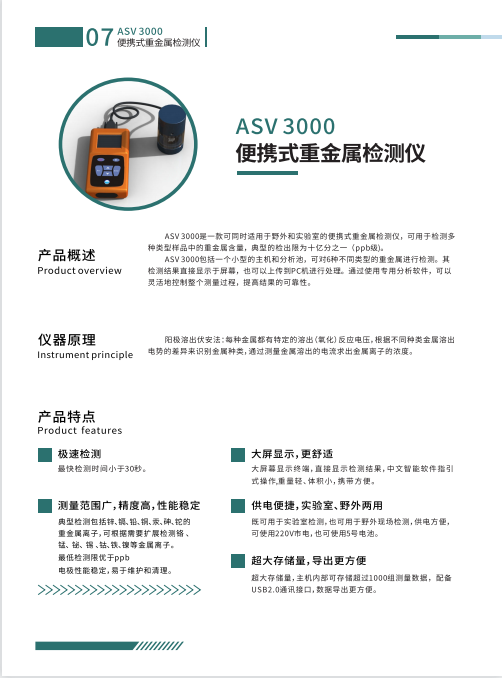
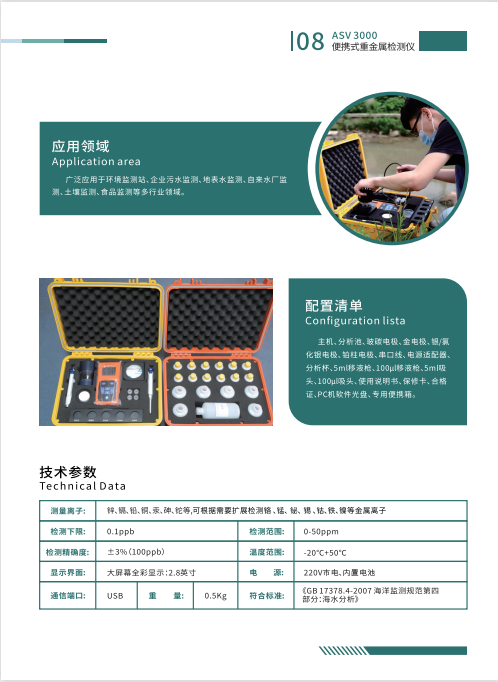
ASV 3000, a portable heavy metal detector under Mingqin Technology, is suitable for both field and laboratory use. It can be used to detect heavy metal content in various types of samples, with a typical detection limit of one billionth (ppb level). Including a small host and analysis pool, capable of detecting 6 different types of heavy metals. The detection results are directly displayed on the screen and can also be uploaded to a PC for processing. By using specialized analysis software, the entire measurement process can be flexibly controlled to improve the reliability of the results.