

Recently, the Ministry of Ecology and Environment issued opinions on strengthening the prevention and control of heavy metal pollution, encouraging the public to actively participate, fully leveraging the role of industry associations and other social organizations, and consciously fulfilling social responsibilities. At the same time, it was mentioned to actively expand funding sources and support the governance of historical legacy issues related to heavy metals. Strengthen emergency management of heavy metal pollution, and local ecological and environmental departments will incorporate emergency response plans for heavy metal pollution into local emergency response plans in accordance with the "One River, One Strategy, One Map" policy. Strengthen emergency material reserves, regularly conduct emergency drills, and continuously improve environmental emergency response capabilities.
During the 13th Five Year Plan period, positive results have been achieved in the prevention and control of heavy metal pollution. At the same time, it should be noted that heavy metal pollution is still prominent in some areas, posing a threat to ecological environment security and public health. The prevention and control of heavy metal pollution is a long and arduous task. According to the Opinions of the Central Committee of the Communist Party of China and the State Council on Deepening the Battle of Pollution Prevention and Control, this opinion is formulated to further strengthen the control of heavy metal pollutant emissions and effectively prevent and control environmental risks related to heavy metals.
1、 Guiding ideology
With the goal of effectively preventing and controlling the environmental risks of heavy metals, taking the reduction of key heavy metal pollutants as the key point, adhering to the general working principle of seeking progress while maintaining stability, and insisting on precise, scientific and law-based pollution control, we will carry out in-depth comprehensive management of heavy metal pollution in key industries, effectively control heavy metal pollution in key areas, and earnestly safeguard ecological and environmental security and the health of the people.
2、 Key points of prevention and control
Key heavy metal pollutants. The key heavy metal pollutants for prevention and control are lead, mercury, cadmium, chromium, arsenic, thallium, and antimony, and total emission control is implemented for the five key heavy metal pollutants of lead, mercury, cadmium, chromium, and arsenic.
Key industries. This includes six industries: heavy non-ferrous metal mining and selection (copper, lead and zinc, nickel cobalt, tin, antimony, and mercury mining and selection), heavy non-ferrous metal smelting (copper, lead and zinc, nickel cobalt, tin, antimony, and mercury smelting), lead-acid battery manufacturing, electroplating industry, chemical raw material and chemical product manufacturing (calcium carbide (poly) vinyl chloride manufacturing, chromium salt manufacturing, zinc inorganic compound industry using industrial solid waste as raw material), and leather tanning processing industry.
Key areas. Based on the emission status of heavy metal pollutants, environmental quality improvement, and environmental risk prevention and control needs, key areas for heavy metal pollution prevention and control are designated.
Encourage localities to identify key heavy metal pollutants, industries, and regions beyond the above requirements based on local ecological environment quality improvement goals and heavy metal pollution status.
3、 Main objectives
By 2025, the emissions of key heavy metal pollutants in key industries nationwide will decrease by 5% compared to 2020, the level of green development in key industries will improve rapidly, the capacity for heavy metal environmental management will be further enhanced, and efforts will be made to address a number of prominent historical legacy heavy metal pollution issues.
By 2035, establish and improve the system and long-term mechanism for preventing and controlling heavy metal pollution, comprehensively enhance the ability to control heavy metal pollution, environmental risk prevention and control, and environmental supervision, and effectively control heavy metal environmental risks.
Expand reading:
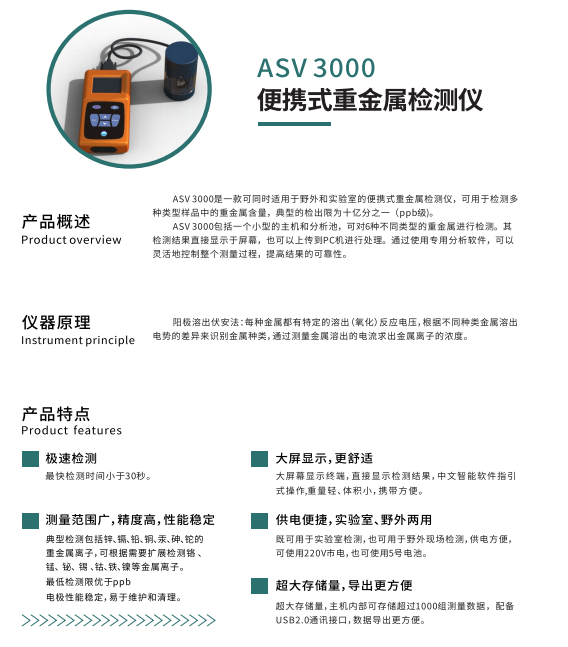
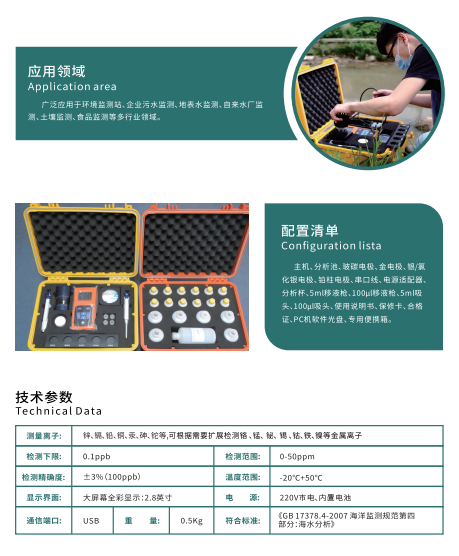
ASV 3000, a portable heavy metal detector under Mingqin Technology, is suitable for both field and laboratory use. It can be used to detect heavy metal content in various types of samples, with a typical detection limit of one billionth (ppb level). Including a small host and analysis pool, capable of detecting 6 different types of heavy metals. The detection results are directly displayed on the screen and can also be uploaded to a PC for processing. By using specialized analysis software, the entire measurement process can be flexibly controlled to improve the reliability of the results.