Standard Revision | Formally Implemented on June 1st!
Source:生态环境部网站 | Release time:2022-04-06 | Share:
This standard is the first revision of the "Technical Requirements and Detection Methods for Continuous Automatic Monitoring System of Environmental Air Particulate Matter (PM10 and PM2.5)" (HJ 653-2013) and will be implemented on June 1, 2022.
To implement the Environmental Protection Law of the People's Republic of China and the Air Pollution Prevention and Control Law of the People's Republic of China, prevent and control ecological environment pollution, improve ecological environment quality, and standardize the performance and quality of continuous automatic monitoring systems for particulate matter (PM10 and PM2.5) in the ambient air. This standard specifies the technical requirements, performance indicators, and detection methods for continuous automatic monitoring systems of ambient air particulate matter (PM10 and PM2.5).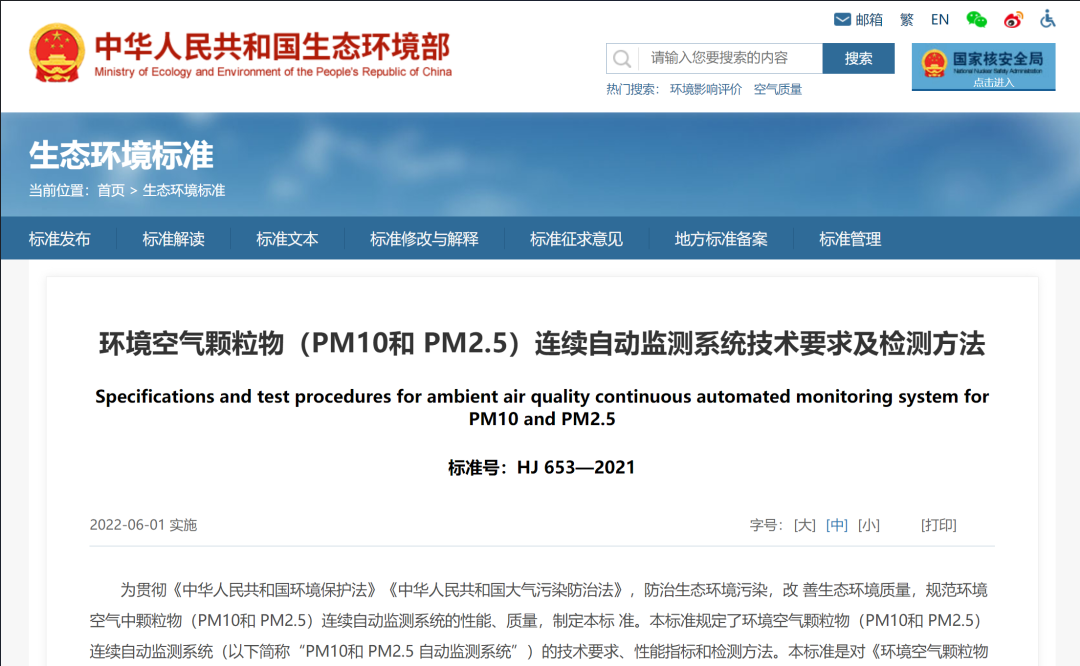
scope of application
This standard specifies the technical requirements, performance indicators, and detection methods for continuous automatic monitoring systems of ambient air particulate matter (PM10 and PM2.5).
This standard is applicable to the design, production, and testing of continuous automatic monitoring systems for ambient air particulate matter (PM10 and PM2.5).
Background and Significance of Revision of Technical Requirements
In 2013, the Ministry of Ecology and Environment formulated and released the "Technical Requirements and Detection Methods for Continuous Automatic Monitoring System of Environmental Air Particulate Matter (PM10 and PM2.5)" (HJ 653-2013, hereinafter referred to as the original "Technical Requirements"). Since the implementation of the original "Technical Requirements", the performance and quality of automatic monitoring instruments for ambient air particulate matter have been standardized and improved. China's atmospheric environmental governance has achieved significant results, but particulate matter is still the main pollutant in the ambient air of many cities.During the 14th Five Year Plan period, we will deepen the defense of blue skies and continuously improve air quality. Higher requirements have been put forward to further enhance the stability, accuracy, and sensitivity of automatic monitoring instruments for environmental air particulate matter. It is necessary to revise the original Technical Requirements.One is to moderately increase the requirements for relevant technical indicators based on the development status of automatic monitoring technology for ambient air particulate matter and the needs of atmospheric environmental quality management.The second is to further coordinate and consider factors such as particulate matter concentration, environmental conditions, and climate characteristics, and improve the requirements for the location and time of instrument performance testing.The third is to focus on hardware and software settings that affect data quality, and clarify the regulations for key components and important parameters of automatic monitoring instruments.
The characteristics and main contents of the revision of the Technical Requirements
This revision is based on the existing standards in China, with reference to relevant foreign standards, combined with technical status and management needs, and appropriately improves the performance indicators of automatic monitoring instruments for environmental air particulate matter, and improves relevant regulations. Mainly reflected in the following aspects.
One is to tighten the accuracy technical requirements for the comparison and testing indicators between automatic and manual monitoring methods of environmental air particulate matter.
Secondly, it has been clarified that comparative testing should be conducted in multiple regions and seasons to improve the systematic nature of instrument comparative testing under different environmental quality conditions, temperature and humidity conditions, and enhance the applicability of instruments.
The third is to standardize the management requirements for the display, recording, and storage of important parameters such as sample temperature and humidity.
Fourthly, the compatibility of instrument principles has been maintained, and specific instrument methods and principles have not been specified, encouraging technological innovation and development.
The revision of the Technical Requirements has had a significant impact
The implementation of this revision plays an important role in improving the quality of monitoring data, supporting atmospheric environment supervision, promoting monitoring technology progress and industrial development.Mainly reflected in the following aspects:Firstly, the technical performance requirements for automatic monitoring instruments for environmental air particulate matter have been comprehensively strengthened, and regulations on instrument hardware configuration, parameter settings, and other aspects have been improved. The main indicators have reached the strictest level under current technical conditions, laying a solid foundation for further ensuring and improving the quality of automatic monitoring data for particulate matter.The second is to standardize the technical standards for the performance and quality of automatic monitoring instruments, further improving the accuracy and comparability of monitoring data from the source, and effectively supporting the fine management of atmospheric environmental quality under the downward trend of particulate matter concentration.Thirdly, we will guide relevant instrument manufacturing enterprises to further increase their research and development efforts, improve product performance, ensure product quality, promote the upgrading of the particle automatic monitoring instrument industry, enrich the market supply of particle automatic monitoring equipment, and actively support the deepening of the blue sky defense war.Click to download (official electronic version of standard text)