



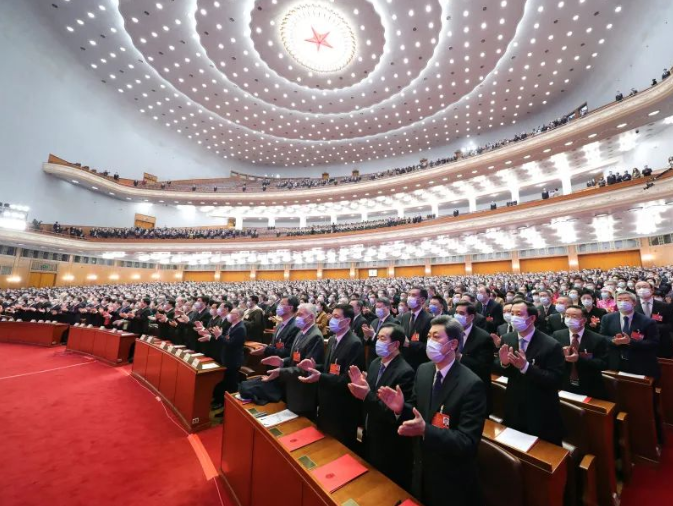
Closing Meeting of the Fifth Session of the Thirteenth National People's Congress
At this year's National People's Congress and Chinese People's Political Consultative Conference, the Central Committee of the Communist Party of China submitted a proposal to the Fifth Session of the Thirteenth National Committee of the Chinese People's Political Consultative Conference, suggesting a comprehensive investigation and scientific assessment of VOCs emissions. Considering the differences in its characteristics and main emission sources, develop targeted investigation and evaluation rules, fully considering the key links involved in VOCs emissions.
During the 13th Five Year Plan period, various regions have started to investigate the main sources and emissions of VOCs, and have revised key industry VOCs emission standards and management systems. Some industries have basically achieved VOCs reduction throughout the entire process from raw materials to products, from production to consumption. However, as an indicator for air quality supervision and assessment during the 14th Five Year Plan period, the management of VOCs still faces challenges.
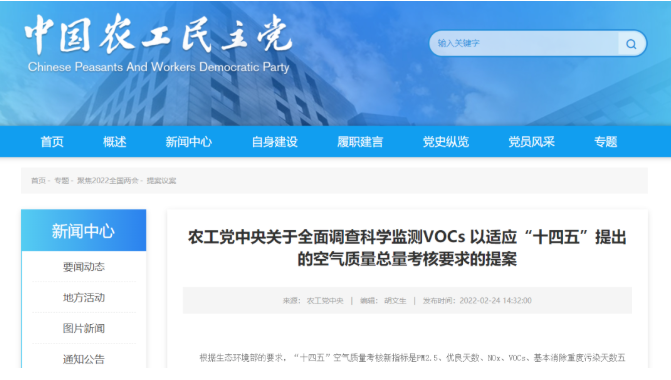
稿件来源:农工党中央网站
Therefore, let's listen to the voices about VOCs during the Two Sessions together
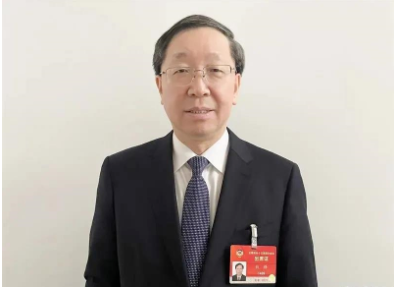
Qian Feng, a member of the National Committee of the Chinese People's Political Consultative Conference
Qian Feng, member of the National Committee of the Chinese People's Political Consultative Conference, academician of the CAE Member, and vice president of East China University of Science and Technology, delivered a speech at the conference entitled "Accelerating the construction of an integrated air quality monitoring network to lay a solid foundation for green development in the Yangtze River Delta".
1. Strengthen VOCs component monitoring and share VOCs component monitoring data
Qian Feng stated that air quality monitoring, as a fundamental task in ecological environment construction, particularly requires an overall layout in accordance with the requirements of "ecological environment protection and governance", providing strong support for green development in the Yangtze River Delta region. However, there are still some issues with the air quality and monitoring network construction in the Yangtze River Delta region at present.
Qian Feng mentioned that the Action Plan for the Construction of the "Three Unifications" System for Ecological Environment Management in the Yangtze River Delta Ecological Green Integration Development Demonstration Zone was recently issued, proposing to implement environmental monitoring linkage and environmental quality data sharing in the demonstration zone. He suggested accelerating the construction of the Long Triangle Integrated Air Quality Monitoring Network on this basis.
One is to conduct research on the current monitoring situation. Conduct research on the current status, location, surrounding environment, and functional attributes of national, provincial, municipal, and some county-level air quality monitoring points in the Yangtze River Delta region, sort out the functional attributes of each monitoring station and the needs of various cities, and integrate existing air quality monitoring resources. Based on the location function and regional positioning, a network platform for joint release of air quality in demonstration cities such as Shanghai, Hangzhou, Nanjing, and Hefei will be established in advance.
The second is to establish phased construction goals. According to the construction of air monitoring stations and network platforms in various cities, gradually expand the access points of regional air monitoring networks. Optimize the air monitoring network and strive to cover urban stations, transportation stations, background stations, transmission channel points, etc. In addition to routine monitoring of six factors and six meteorological parameters, it is necessary to strengthen and improve the monitoring of particulate matter and volatile organic compound components. Each city is required to share one volatile organic compound (VOCs) component monitoring data and connect it to the regional shared air release platform.
The third is to strengthen the sharing of monitoring data. Strengthen the sharing of air quality monitoring data within the region, enhance the analysis of air pollution sources, confirm regional transmission paths, and analyze the causes of heavy pollution weather. Targeted promotion of air monitoring and meteorological data sharing mechanism in the Yangtze River Delta region, incorporating data from regional air quality super stations and related meteorological stations into the data platform, providing important references for air pollution case analysis, analysis and warning of air pollution under similar weather conditions, and also providing a basis for the formulation of prevention and control measures.
The fourth is to unify monitoring standards and quality control systems. Unify the atmospheric emission standards for key sources and achieve the integration of industry emission standards and access mechanisms in the Yangtze River Delta region. Based on the emission lists and enterprise directories of various regions, identify key air pollution control enterprises and industries that contribute significantly to PM2.5 and O3, and implement unified scheduling during regional joint prevention and control of fixed source air pollutants, data sharing, and heavy pollution weather for key enterprises in the region. Implement unified quality control and assurance for sites connected to the network, so that the management of regional air quality monitoring has unified standards and control.
The fifth is to establish a monitoring information disclosure mechanism. On the basis of the preliminary improvement of the integrated air quality monitoring network in the Yangtze River Delta region, and drawing on the experience of the Guangdong Hong Kong Macao Greater Bay Area, we will release routine monitoring factors and real-time air quality ratings of major cities in the Yangtze River Delta region to the society. Through public supervision, we will further improve the air quality in the Yangtze River Delta region.
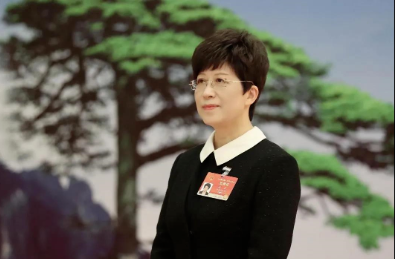
Ling Yun, deputy to the National People's Congress and mayor of Hefei, submitted the Proposal on Regulating the Market Behavior of Social Environmental Monitoring Institutions during the two sessions of the National People's Congress this year.
2. County level environmental monitoring stations do not yet have the ability to monitor VOCs! Social environmental monitoring companies need to regulate and constrain
Ling Yun stated that as the country's requirements for ecological environment management continue to increase, the scope, indicators, and frequency of ecological environment monitoring are becoming increasingly strict, and the corresponding workload has also significantly increased. But after the reform of the vertical management system for monitoring, supervision, and law enforcement of environmental protection agencies nationwide, all personnel from the original municipal environmental monitoring stations were transferred to the provincial level, and monitoring stations were no longer established at the municipal level. Monitoring matters can only be undertaken by county-level monitoring stations or commissioned social environmental monitoring agencies.
From the perspective of monitoring capability, county-level monitoring stations do not yet have the ability to monitor pollutant indicators such as VOCs. However, social environmental monitoring institutions started late, with shortages of professional testing personnel, irregular internal management, and vicious competition disrupting market order, which has affected the objectivity, impartiality, and standardization of monitoring. ”Ling Yun said.
Ling Yun pointed out that social environmental monitoring institutions are constantly growing and playing an important role in the construction of ecological civilization. However, at the national level, no normative opinions have been issued to regulate the industry access, business scope, capability recognition, operation management, and supervision management of socialized environmental monitoring institutions. At present, as long as socialized monitoring institutions pass the metrological certification of provincial quality supervision and management departments, they have the qualification to provide legally effective monitoring data to the society and can carry out environmental testing services.
But this certification is only for the qualification recognition of laboratories, and there are no specific requirements for the personnel configuration, quality management system, and institutional operation mechanism of social monitoring institutions. Institutions that pass the certification may not necessarily have the corresponding testing capabilities.
Based on this, Ling Yun suggests that relevant policies, regulations or guidance be introduced at the national level to clarify the law enforcement subject status of ecological environment departments in regulating social environmental monitoring agencies, further regulate the market behavior of social environmental monitoring agencies, and guide the orderly development of the third-party environmental monitoring industry.
Disclaimers
Text and image sources: This article is compiled online for sharing and communication purposes only, and has not been used for any commercial purposes. We maintain a neutral stance on the viewpoints presented in the article, which are for reference and communication purposes only. The copyright of the text content and images belongs to the original author. We respect originality, and if there is any infringement, please contact us promptly for handling!


